As affordability challenges and demographic shifts impact what is desirable and attainable for homebuyers, builders are quietly reshaping what the “typical” home looks like in America.
New data from the National Association of Home Builders reveals some clear patterns: Homes are getting smaller, floor plans are more efficient and feature-packed, and outdoor living spaces now outrank less functional amenities.
“Smaller and sexier. Floor plans are getting smaller, but in that getting smaller, they have to be more feature‑packed. They have to be more interesting. They have to use the space better,” Donald J. Ruthroff, an architect in the San Francisco Bay Area, said in a presentation at the International Builders Show in Orlando, FL, on Wednesday.
During the session, Rose Quint, assistant vice president for survey research at the NAHB, said that while new homes are shrinking from their pre‑pandemic peak in terms of square footage, builders are adding more features in response to consumer tastes.
According to an NAHB analysis of Census Bureau data, the average new‑home size was about 2,155 square feet in 2025, down roughly 300 square feet from 10 years ago, when the typical home was 2,475 square feet.
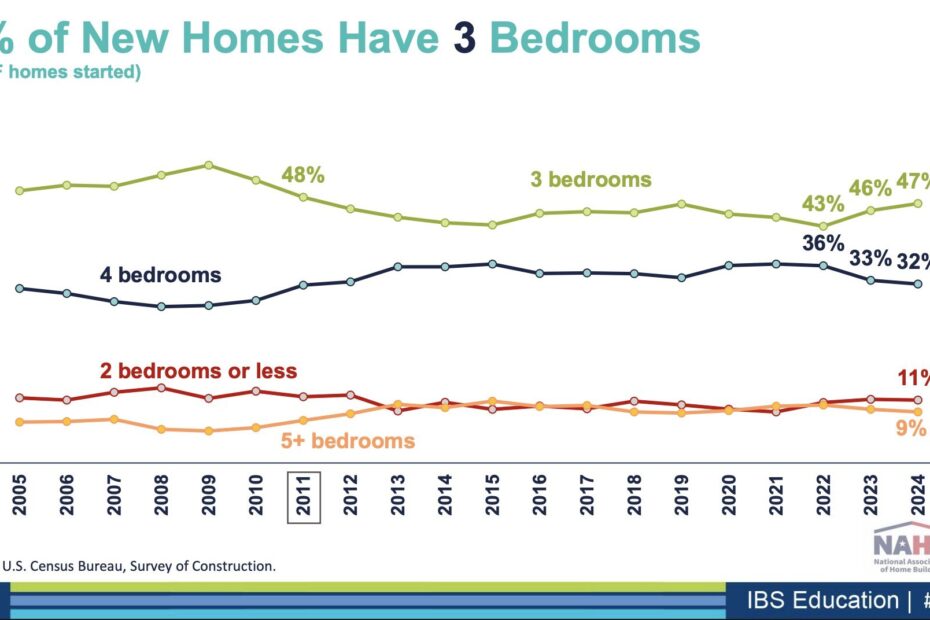
Buyers are also increasingly gravitating toward three‑bedroom homes. In 2025, 47% of new homes had three bedrooms, marking the highest share since 2011.
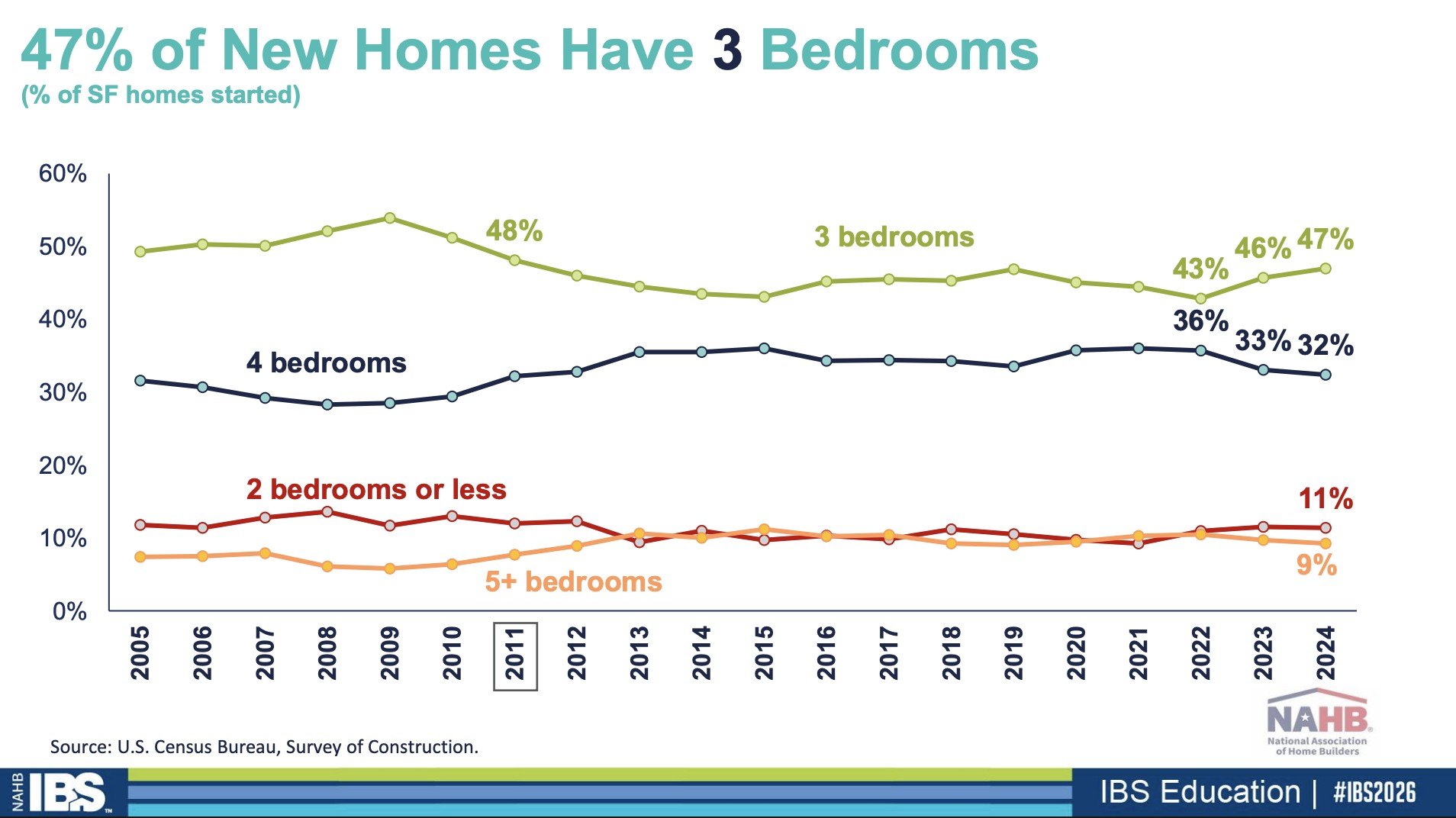
Meanwhile, the share of new homes that have four bedrooms has slid to just 32%. Bathrooms are shifting similarly: 65% of new homes now have only two full baths, and the share with three baths is edging down.
These changes reflect both affordability constraints and the evolving demographics of homebuyers, with more single‑person households, fewer families with multiple children, and the average age for both marriage and homeownership continuing to rise.
Key home features for entry‑level vs. high‑end buyers
Quint’s buyer research shows a sharp contrast between what entry‑level and high‑end buyers consider nonnegotiable.
High‑end or luxury buyers, Quint said, are “demanding.” They rate 69 different features as “strongly wanted” (indicating more than 75% of respondents see them as essential) across kitchens, green features, technology, outdoor spaces, and specialty rooms like home offices.
“We gave these buyers over 200 features of the home and the community, and what we found is that high‑end buyers have very, very strong preferences for dozens and dozens of features,” said Quint.
Entry‑level buyers, by contrast, are much less demanding, rating only a handful of features as essential.
“Your entry‑level buyer understands his situation a lot better. For this group, only 18 are absolutely essential, must‑have features,” said Quint. “Everything else for them is negotiable. They’re looking for an affordable home.”
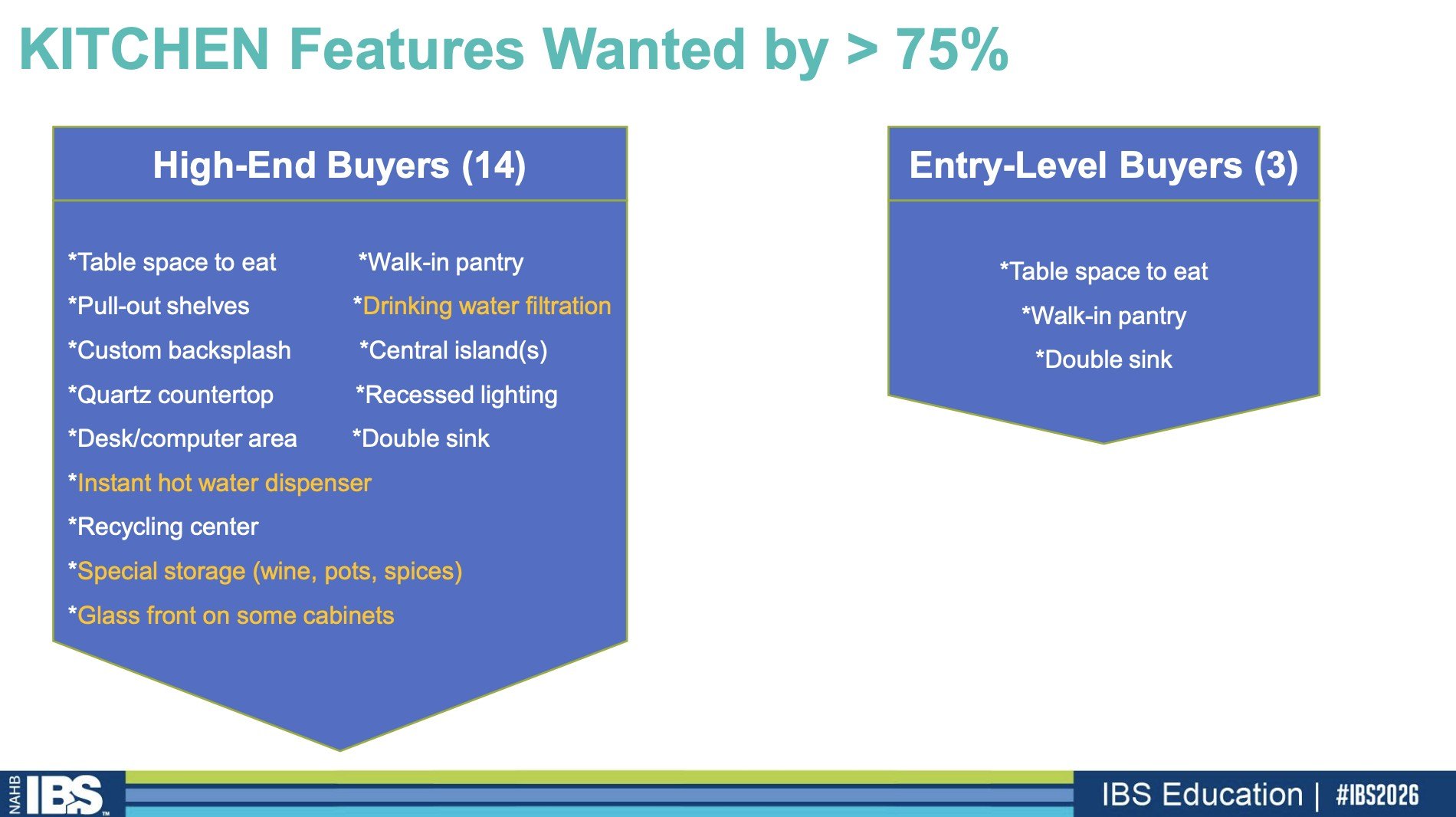
Entry-level buyer priorities are basic and practical, focusing on amenities such as eat‑in kitchens, walk‑in pantries, laundry rooms, some garage storage, and a handful of energy‑efficient upgrades such as Energy Star–rated appliances.
Many “nice‑to‑have” items, such as elaborate smart home systems or exotic finishes, fall off the list if they potentially push the home’s price out of reach.
Yet one feature is considered essential across all price points: a full bathroom on the main level. Both first‑time and high‑end buyers say it’s critical, whether for aging in place, multigenerational living, or convenience in hosting guest.
“If you’re a builder thinking about cutting out the full bath on the main level to save money … I would recommend to think on that one more time, because first‑time homebuyers, entry‑level buyers, and high‑end buyers really, really want to have their full bath on the main level,” said Quint.
Outdoor space becomes the second living room
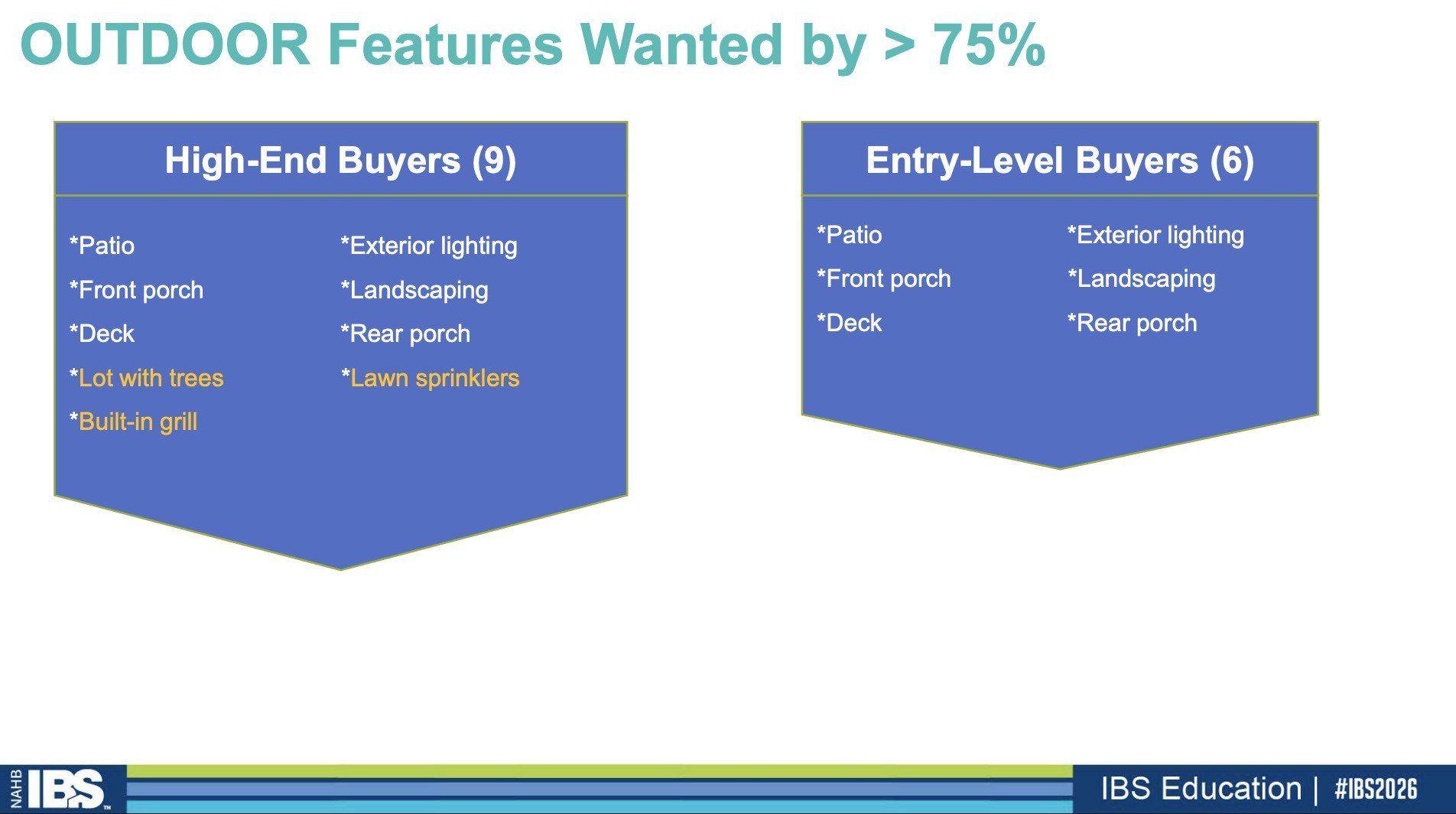
As interior floor plans get tighter, outdoor spaces are where many builders are adding value, and another realm where buyer preferences line up consistently across income levels.
The NAHB survey data shows both entry‑level and high‑end buyers strongly prefer homes with patios,
front porches, decks, rear porches, landscaping, and exterior lighting.
“Outdoor features are important for both groups of people,” said Quint. “This is where I would concentrate any extra money that you may have, in adding some of these features to the home.”
On the design side, Ruthroff argued that outdoor space has effectively become a second living and dining area for families, and said homebuilders should treat it as such, even on small lots.
In model homes, that means fully furnishing compact backyards, side courtyards, and patios to show how they can function as day‑to‑day living spaces.
“I encourage you to really deck it, really show people that that smaller space is still incredibly useful, because they want it,” said Ruthroff. “It’s now the second living space. It’s now the second dining space. And so they want that, so make sure that they can see it.”
In denser urban projects, where backyards are rare, roof decks are increasingly the answer. From for‑rent communities in Tempe, AZ, to new infill townhomes and multifamily projects in cities like Sacramento, CA, and Nashville, TN, roof terraces now host pools, lounges, dog runs, and communal gathering areas.
“You can see how important roof space has become in the urban context,” said Ruthroff. “It’s expensive, I know, but it’s important when you get down into a dense situation to still be thinking about, ‘How do I get my homeowners outside?’”
‘Smaller and sexier’ floor plans
Inside the home, builders are adapting to shrinking floor plans by making every square foot work harder.
Instead of long hallways or oversized formal rooms, modern plans favor open great rooms, L‑shaped living and kitchen layouts, and compact but functional kitchens with islands and walk‑in pantries.
“Function before show,” said Ruthroff. “The idea that the kitchen is a showpiece is important, but it really has to function, because oftentimes it’s smaller than it used to be. So it needs to do more.”
For buyers, the net effect is a clear shift away from raw size and lesser-used formal rooms, and more emphasis on function, storage, and smart layouts that fit both how people actually live and what they can realistically afford.