
American retirees stand to lose an average of $500 a month from their Social Security payments in the next seven years if nothing is done.
For the past 16 years, the cost of the Social Security retirement program has exceeded the amount it receives from taxes collected, forcing it to dip into its trust fund reserves to cover the shortfall.
It has been widely reported that by 2032, those reserves will be depleted, and if there is no intervention, seniors will have to learn to live with far less than before.
How much more is the focus of the Committee for a Responsible Federal Budget’s latest analysis. Its findings conclude that at a national level, everyone’s benefits could see a 24% decline, equaling a $500 average monthly loss.
But seniors in some states will lose far more than that, and losing that money could actually put their homes at risk.
The most vulnerable seniors in the U.S.
“No state would be spared from the potentially devastating effects of insolvency,” CRFB warned in its report as it examines just how much money seniors would lose per month once the Social Security reserves are cashed out.
While it calculated the average to be $500 lost per month, beneficiaries in 29 states would see an even deeper cut to their checks.
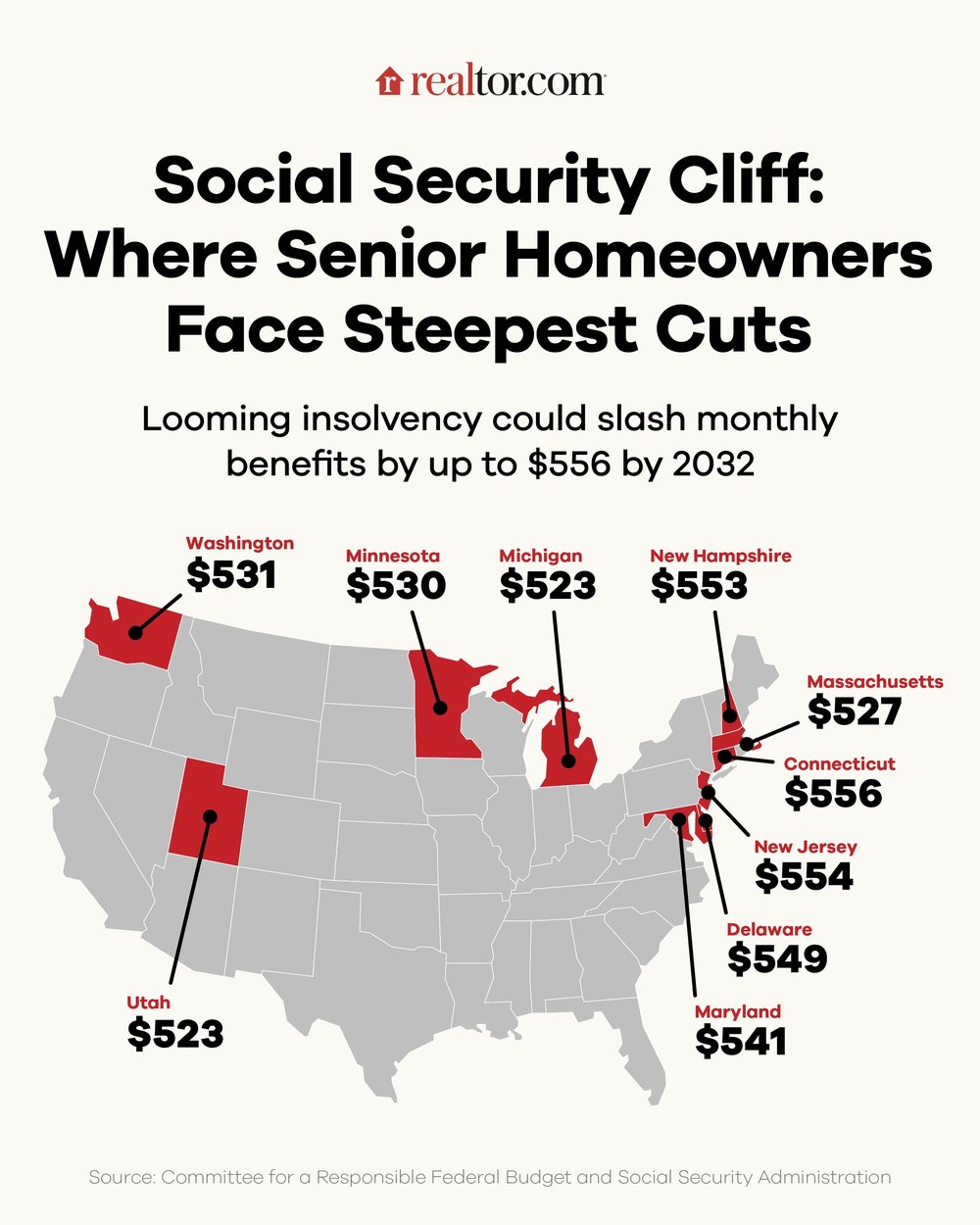
The hardest hit will be seniors in the Northeast, with those in Connecticut poised to lose $556 a month in benefits, followed close behind by New Jersey ($554) and New Hampshire ($553).
Nearby Delaware and Maryland beneficiaries would feel an equal sting, losing $549 and $541, respectively. The remainder of the top 10 states feeling the deepest cuts were Washington ($531), Minnesota ($530), Massachusetts ($527), Michigan ($523), and Utah ($523).
Along with quantifying projected reduction at the state level, the CRFB also calculated how much of the overall population would be affected.
One in 5 Americans—63 million in total—would be affected if Social Security’s retirement program faced a 24% cut.
According to the report, between 10% and 23% of each state’s population would be affected by the cut, with the largest share facing benefit cuts in Maine, West Virginia, Vermont, Delaware, Montana, and New Hampshire.

Seniors need Social Security benefits to keep their homes
Managing life on a fixed income is a reality for most seniors. As they are poised to lose over $500 a month from their budgets, the reality is that their homes could be at risk, even if their mortgages are paid off.
Nearly 22 million seniors are estimated to live on Social Security alone, according to a June 2025 study from The Senior Citizens League. In the past five years, the cost of homeownership has jumped 26% as expenses such as insurance, property taxes, and maintenance continue to rise.
As it stands, retirees are already facing shortfalls as great as thousands of dollars per year when it comes to managing their housing costs with Social Security.
In fact, currently, Social Security alone is enough to cover the living expenses in only 10 states, according to the Realtor.com® analysis of median Social Security benefits by state and the Elder Economic Security Standard Index.
But the math changes once these Social Security payments take a hit.
For instance, let’s look at Delaware. Delaware tops the list of states where seniors can currently get by on Social Security alone, with an annual surplus of $1,764, or about $147 a month, according to Realtor.com analysis.
The median monthly benefit stands at $2,139, with monthly housing costs coming in at around $555 (assuming that the mortgage is paid off) and total monthly costs, which include healthcare, transportation, food, and more, averaging $1,992, according to the Elder Economic Security Standard Index.
Now, let’s fast-forward to 2032. We’ll have to make some assumptions, like the cost-of-living adjustment for Social Security going up yearly by 3% and other costs getting hit by inflation, currently at 3.8%.
That would put Social Security benefits for Delaware seniors at about $2,631, with total monthly costs at $2,586. While they technically stay in the black, their cushion shrinks to a meager $45 a month—and that’s before the projected $549 benefit cut takes their budget entirely into the red.
What happens now
To be blunt, America has less than seven years to find a solution to help not only seniors nearing the brink in their retirement, but also the future generations who have been paying into the program.
“Americans fall into two different camps: those who want to do something about it and those who want to push this off to the next generation,” Dan Rothschild, director of the Center for Civics, Education, and Opportunity at the Reagan Institute, told Fox Business following the release of the institute’s Reagan National Economic Survey in May.
Solutions range from raising payroll taxes to increasing the retirement age from 67 to 70. However, according to the survey, the prospect of higher taxes was opposed by 80% of voters, while reducing Social Security benefits faced even stronger opposition, with 90% against the idea.
So far, President Donald Trump’s focus has been on preparing the next generation for retirement apart from Social Security. In May, he signed an executive order aimed at increasing retirement savings access for Americans not currently covered by a 401(k) or other workplace retirement plans.
On the other hand, his One Big, Beautiful Bill has been projected by experts to be a detriment to the continuation of Social Security. By providing tax breaks, like not taxing tips and overtime, and even the senior deduction, less earned income will be exposed to the payroll tax between 2025 and 2028, meaning the program will collect less income.
As Washington continues to weigh options, the clock continues to tick for the 22 million Americans who don’t have the luxury of time. For them, Social Security isn’t a political talking point or a line item in a future budget—it is the thin line keeping them in their homes.
And that line is wearing dangerously thin.