In 1982, Dorris Reed bought a California house for $76,000. What she didn’t know, is that a woman and her four children had been murdered there 10 years earlier.
Reed learned about the killings only after she’d moved in, when neighbors told her what had happened—and that other buyers had reportedly walked away from the home because of its dark past.
It’s a nightmare plenty of homeowners and buyers have apparently imagined themselves. Key phrases like “how to find out if someone died in my house” receive thousands of online queries every month.
But Reed’s story also raises a more basic question: Shouldn’t someone have had to tell her?
Nearly 50 years later, and the answer today still depends on where the home is located, how the person died, when it happened, and even whether the buyer asks.
Start with your state’s disclosure laws
The seller of Reed’s home, Robert King, and his real estate agents knew about the killings, according to her lawsuit. They also allegedly knew the home’s history affected its market value.
Still, Reed said, they didn’t tell her.
Instead, they described the property as being in good condition and suitable for an “elderly lady” living alone. King had even gone so far as asking a neighbor to keep quiet about the murders.
Today, a California buyer in Reed’s position would have stronger statutory protections—but only up to a point.
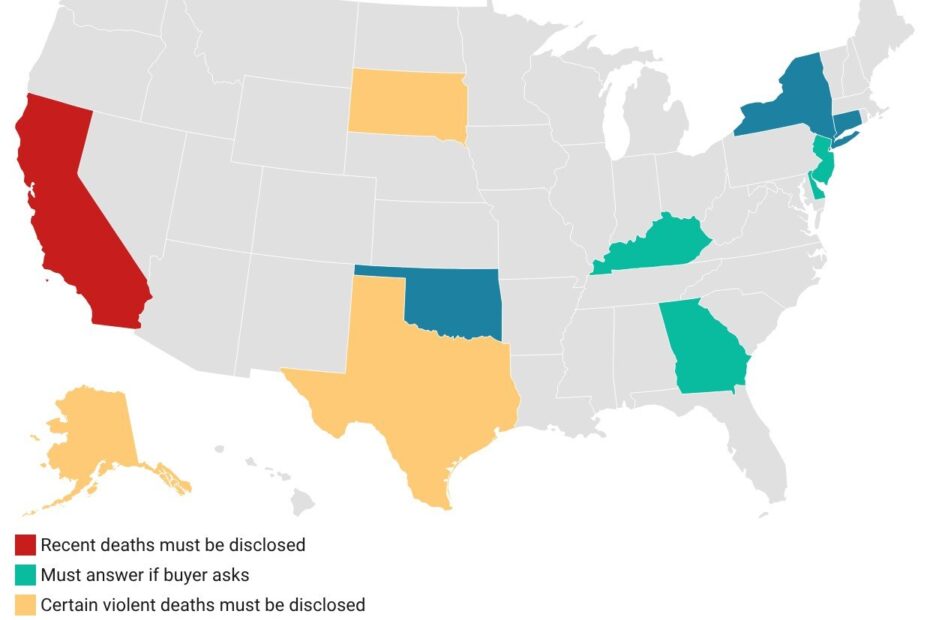
State law requires sellers and agents to disclose a death that occurred on the property within the previous three years. Reed’s case involved murders that had happened a decade earlier, meaning the same events would now fall outside that three-year automatic disclosure window.
And the Golden state is an outlier.

Most states don’t require sellers to proactively disclose that someone died in a home. Some expressly treat deaths, homicides, or suicides as psychological stigmas rather than physical defects affecting the property’s safety or condition.
A smaller group draws narrower lines. Alaska and South Dakota impose disclosure requirements for certain murders, homicides, or suicides. Texas exempts natural deaths, suicides, and accidents unrelated to the property’s condition, while known murders must be disclosed.
In Delaware, Georgia, and New Jersey, the buyer’s question itself can matter: Sellers or real estate professionals generally don’t have to volunteer certain deaths, but they can be required to provide information after a qualifying inquiry.
That means the absence of anything on a seller’s disclosure does not necessarily mean no one died in the home.
Check public records for deaths at your address
A buyer today has more tools than Reed did, but there’s still no national government database that can tell you every person who died at a particular address.
That’s why YK Kuliev, founder of Fast Home Buyer California, says you have to think local.
“If you’re trying to find out if someone passed away in your home, the first place to start is public records,” he explains.
Most municipalities have a vital records office, which records births and deaths in the area. Since these records are kept by local governments, though, the process to search them will vary from place to place. Your local office should be able to advise you on the best process to initiate your search.
Keep in mind, though, the public record isn’t perfect.
“What you need to be aware of is that records aren’t always complete,” says Riley Beam, managing attorney of Douglas R. Beam, P.A. “Some death records might only be maintained for a limited time, and gaps can occur due to privacy restrictions or historical record-keeping practices.”
For example, the Social Security Death Index—a comprehensive repository of every death reported to the Social Security Administration—was only maintained between 1962 and 2014.
“The absence of a record doesn’t necessarily mean nothing happened; it could simply be a limitation of the data available,” Beam says.
Ask your neighbors about deaths in your neighborhood
For Reed, this was the step that changed everything. After she moved in, neighbors told her about the murders, along with the crucial piece of information that previous buyers had balked at the home’s history.
Neighbors can still be one of the richest sources of a property’s informal history. They’re the oral historians of your neighborhood and can likely provide you with a lot of information–even your home’s untold history.
Start with the neighbors who have been in your neighborhood a while. If you have a homeowners association, try asking a board member. Or use a property record search to find out who has been there the longest.
Just remember: memories can be flawed. Treat these tips as leads, not fact, and work to triangulate any information you receive with other trusted sources.
Search newspaper archives and online reports
A case like Reed’s would almost certainly have left another trail: local news coverage.
Many libraries maintain public newspaper archives that are free to search and, in some cases, are accessible online. These archives can be a valuable resource for uncovering reports of deaths that may not be available elsewhere.
When searching, focus on obituaries, death notices, and crime reports, particularly in newspapers covering your area.
If you’re unsure where to start, ask your local librarian for assistance. They can guide you to the right resources, help with search techniques, and even suggest additional historical records or databases that may be useful.
Ask your real estate agent about your home’s history
Your real estate agent can be a valuable resource when researching a property’s history. While not all agents will have this information readily available, experienced local agents may have insights from previous sales, public records, or community knowledge.
However, keep in mind that disclosure laws vary by state. In some areas, agents are legally required to disclose deaths that occurred on the property; but in other places, they may only need to share this information if directly asked.
Use a paid service
If all that sounds like a hassle, all you have to do is pay $18.99 to have someone do the work for you.
DiedInHouse.com offers an online service to uncover the history of stigmatized properties, including those with a history of death, crime, fire, or other unusual events.
But remember, property records are an incomplete patchwork of your home’s history. There may be no way to know with certainty whether someone passed away on your property, but triangulating with multiple sources is the best way to find out.
A home’s history can affect it’s value—even if nothing is physically wrong
It’s a lot of work to take on, but it may be worth it, as Reed’s case shows.
Once she learned what had happened, the house no longer looked like the same bargain. She alleged that she had paid $76,000 for a property worth only $65,000 because of the murders—a 14% difference.
Reed sued King and the real estate agents, seeking to undo the sale and recover damages. A trial court initially dismissed her case, concluding that she had not stated a valid legal claim.
But the California Court of Appeal disagreed.
In 1983, it reversed the dismissal and allowed her case to proceed. The court reasoned that a home’s history could be material even when nothing was physically wrong with it. If Reed could prove the murders had a “significant and measurable effect” on the property’s market value, the seller could have had a duty to disclose them.
The judges also rejected the idea that Reed should simply have discovered the murders herself. A multiple murder, the court reasoned, was not something an ordinary buyer could reasonably be expected to anticipate and investigate.
It’s an important lesson for homebuyers today. A death in a home—especially a violent or widely publicized one—can impact how buyers perceive a property even when the roof, foundation, plumbing, and everything else are perfectly sound.
The exact effect on home value is difficult to nail down, though, because it can depend on so many unique and specific factors like the nature of the death, how much publicity it received, local attitudes, how much time has passed, and the strength of the housing market.
And even when a stigma might seem impossible to overcome, it can fade. The Los Angeles home where Charles Manson and his followers murdered Leno and Rosemary LaBianca, for example, still sold for $1.9 million in 2021.