Federal Reserve officials expressed concerns about the economic impact of the U.S. war with Iran at their last interest rate meeting, according to newly released minutes.
The minutes released on Wednesday outline the discussion behind closed doors at last month’s meeting of the Federal Open Market Committee, which concluded with a majority vote in favor of leaving interest rates unchanged.
The meeting on March 17 and 18 came a few weeks into the U.S.-Israeli war with Iran, which entered a fragile two-week ceasefire on Tuesday after President Donald Trump suspended his threats to bomb Iran’s bridges and power plants.
The minutes show many Fed policymakers expressed concerns about the impact a prolonged war and oil price shock would have on both inflation and economic growth in the U.S.
“Participants noted that a prolonged conflict in the Middle East would likely lead to more persistent increases in energy prices and that these higher input costs would be more likely to pass through to core inflation,” the minutes said. “Most participants highlighted the risk that a protracted conflict in the Middle East could weigh on business sentiment and further reduce hiring.”
The minutes show a notable shift in the risk discussion: Almost all participants said upside risks to inflation and downside risks to employment were elevated, and many said those risks increased after the Middle East conflict.
Several officials also pushed their projected timing of future rate cuts further out because recent inflation readings remained troublingly sticky, even before the oil price shock from the war.
“Most participants reiterated, however, that it was too early to know how developments in the Middle East would affect the U.S. economy and judged it prudent to continue to monitor the situation and assess the implications for the appropriate stance of monetary policy,” the minutes added.
The minutes highlighted how an oil price shock presents dual risks to central bankers, who use higher interest rates to fight inflation and lower rates to stimulate the job market.
Fed policymakers have highlighted that dilemma in recent days, with Cleveland Fed President Beth Hammack telling the Associated Press that although she hopes to leave rates unchanged for some time, the next move could be either a hike or a cut.
“I can foresee scenarios where we would need to reduce rates … if the labor market deteriorates significantly,” said Hammack. “Or I could see where we might need to raise rates if inflation stays persistently above our target.”
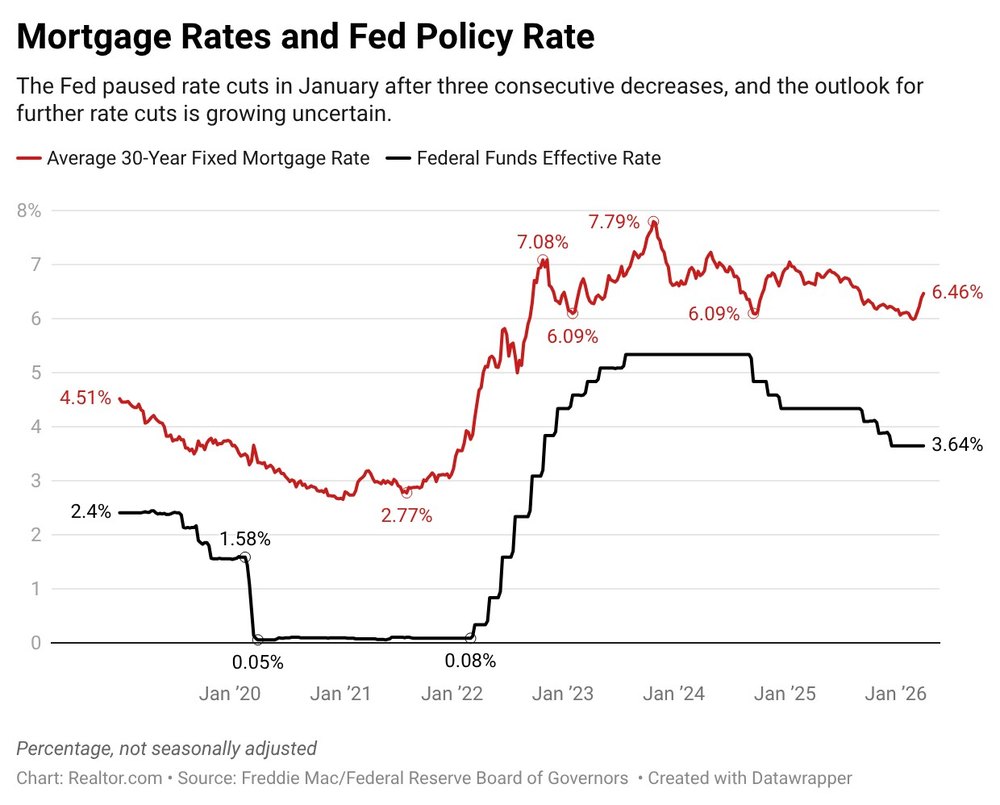
The Fed cut its benchmark overnight rate three times last year, but has left it unchanged in a range of 3.5% to 3.75% since December.
Amid signs of cooling inflation, mortgage rates dipped to a three-year low of 5.89% in February, but since then have surged, reaching 6.46% last week, according to Freddie Mac.
For housing, the new Fed minutes do little to clarify the future path of interest rates, showing a panel that remains concerned with both sides of the dual mandate.
If inflation continues to cool, especially as housing services inflation moderates, the Fed left the door open to cuts at a later date. But Fed officials made clear they are not committed to a preset path.
In the near term, that likely means mortgage rates stay highly sensitive to inflation and oil-price headlines.
That volatility may put a damper on home sales if borrowers grow weary of whipsaw moves in interest rates and lose confidence that rates will remain stable.