Even as California’s homebuilding outpaces population growth, its housing market remains stubbornly tight, new data show—raising questions about what, exactly, is still driving demand.
A new analysis from the Public Policy Institute of California (PPIC) found that the Golden State added 677,000 housing units in six years while gaining only 39,000 residents. In a state long defined by scarcity, that sounds like exactly the kind of imbalance that should finally start to loosen the market.
But the expected slack has yet to appear. Instead, owner vacancy actually fell from 1.2% to 0.8%, and California’s rental vacancy rate was just 4.3% in 2024, far below the 5.9% national rate, according to PPIC’s analysis.
“Even though the state is adding more housing units than people, it was in such a deep hole that the recent successes in homebuilding are not enough to truly move the needle,” explains Joel Berner, senior economist at Realtor.com®.
For perspective, the state estimates it needs 2.5 million more homes over the next eight years, roughly double what is currently planned.
Even so, one might think that reining in a 175-year history of booming population growth might feel more significant—but the report points to another, less obvious force keeping demand high.
‘More roofs for fewer people’
From 2019 to 2024, California lost 82,000 households with children and gained 722,000 households without them, according to PPIC.
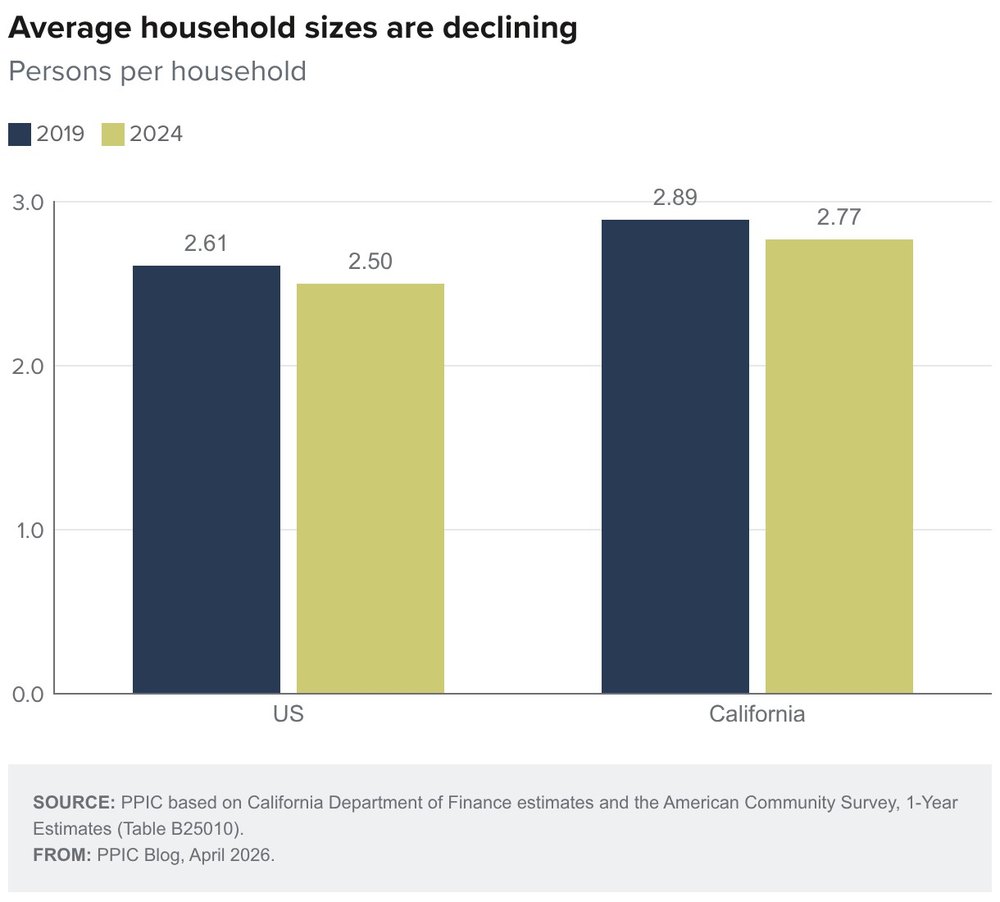
That might sound like a dry demographic shift, but it has major consequences for the market for the simple reason that smaller households use more housing per person.
Think of it this way: A group of five young adults might share a rental in their early 20s; a decade later, those same five people may want three or four separate homes—a one-bedroom apartment, a condo for a couple, a smaller rental for someone living alone.
As Berner puts it, “Fewer people living under the same roof means more roofs are required for the same number of people,” adding that demographic shifts like this can produce exactly the pattern California is seeing now.
California’s aging population is a big part of this shift. Roughly 16.5% of the state’s population is 65 or older today, but that number is expected to reach 24.9% by 2050.
Older adults are more likely to live alone or in two-person households, meaning that even if a population remains flat, as the younger generations age, they will create new demand for new housing. Think again of the group of five young adults—they may be living under one roof today, but by 2050, they’ll all need separate roofs.
It’s not a pattern unique to California, either. Nationally, 72% of renters are now 30 or older, an all-time high, reflecting how delayed household formation is changing who enters the market and when. But in California, where housing has been scarce and expensive for years, the pressure of those shifts is especially acute.
California’s sort-of building boom
For all that pressure, California really is building more housing than it was a few years ago.
PPIC describes the last five years as a period of above-average homebuilding, pushing back on the idea that nothing is changing in the state. Berner agrees, adding that California deserves credit for at least some of the policy shifts that helped make that possible.
“The state has made significant progress from a policy perspective on encouraging ADU construction in recent years, for which it should be commended,” adds Berner. “The state has made efforts to lift local restrictions on ADUs, which is helping it to deliver more and more of them where they are needed the most.”
Still, neither PPIC nor Berner frames that progress as a breakthrough. New homes are arriving, but they’re being claimed almost as quickly as they appear, as evidenced by the low vacancy rates.
Even now, Berner notes, California is home to 11.5% of Americans but accounted for only 7.3% of newly permitted housing units in 2025.
“The pace just isn’t fast enough,” he says.
Why buyers and renters still are not getting relief
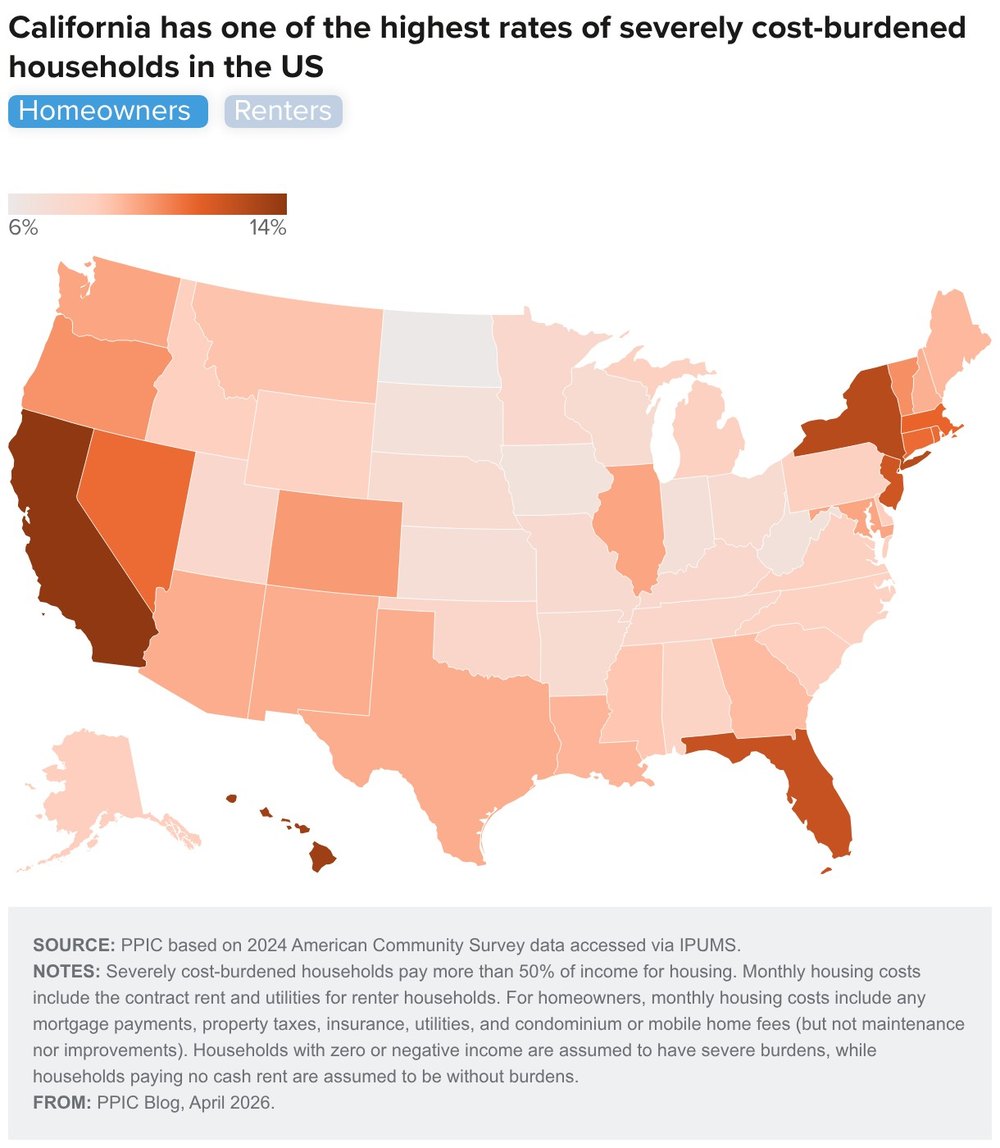
California’s housing shortfall is most evident in what households can actually afford. The state has the highest share of homeowners in the country spending more than half their income on housing costs—14%—and the third-highest share of renters doing the same, at 28%.
That’s to say nothing of how hard it’s been for first-time buyers to break into the market.
Jackie Lam, a freelance writer and accredited financial counselor who rents outside Pasadena, knows that squeeze firsthand. Lam has rented throughout her adult life. Even after getting pre-approved for a mortgage a few years ago, she found the buying market nearly impossible to break into.
“It’s just really, really hard,” she told Realtor.com in March, noting that the homes within reach were mostly small condos—far removed from the three-bedroom starter homes that once defined entry-level homeownership.
And the strain is stretching well beyond the housing market. In a separate 2026 analysis from the Common Sense Institute, California ranked 50th in affordability, ahead of only Hawaii, and remained near the bottom even after taxes were excluded from the model.
The report found California households lost 7.1% of gross income to higher prices from 2019 to 2025 and concluded that today’s affordability crisis is overwhelmingly a shelter problem.
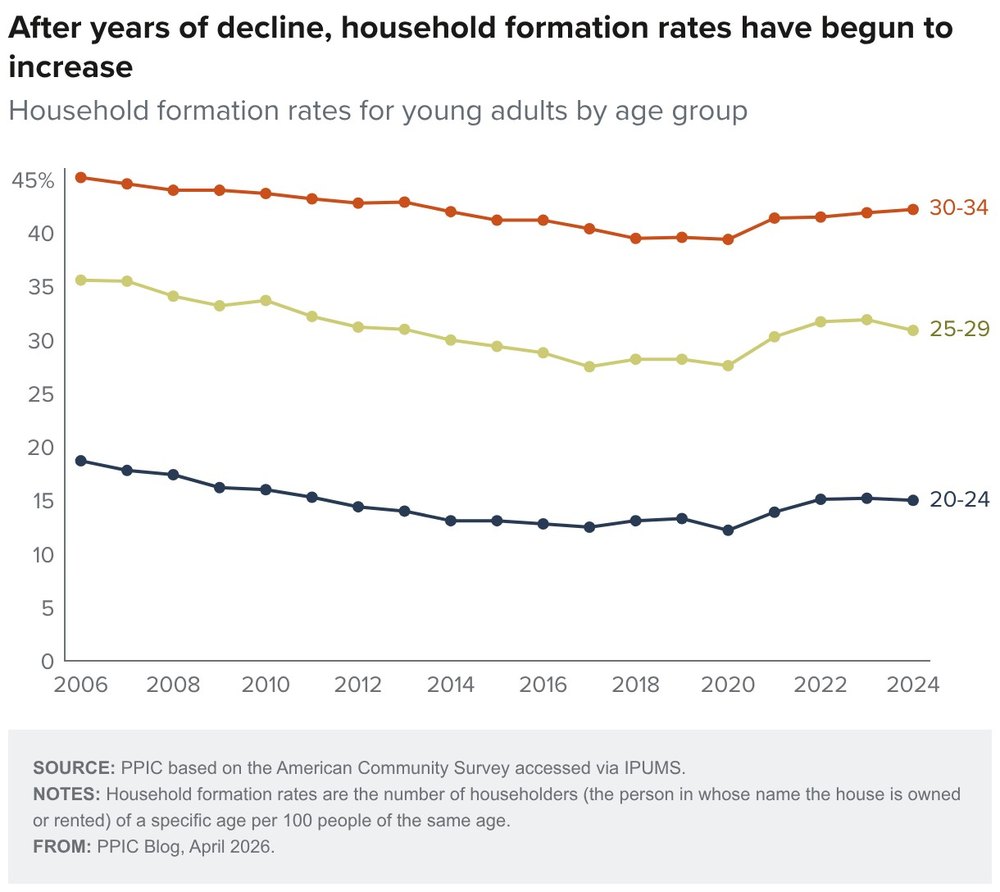
PPIC did find one modest bright spot: a slight rise in household formation among young adults in the Golden State. It’s a sign that some of the most beleaguered segments of the market—young people—are finding footholds and striking out on their own.
But even that encouraging sign comes with a catch. More young adults forming households is only good news if California builds enough lower-cost, entry-level housing for them to afford those next steps.
Right now, that pipeline still falls short. Of the more than 1.2 million housing units currently planned statewide, only 712,000 are designated for moderate-income households or lower—roughly half of what California says it needs.