South Florida didn’t just win the COVID-19 pandemic-era migration boom; it hit the jackpot.
As money drained out of old strongholds like New York, the Sunshine State netted $20.65 billion in annual adjusted gross income from tax filers who moved between 2019 and 2023. Greater Miami alone pulled in $10.5 billion, according to newly released IRS data.
By 2023, the average out-of-state mover arriving in the Magic City was making $178,382.
That’s the kind of income you might expect to feed a homebuying boom, but in some of the biggest hubs of this migration wave, the for-sale market has been oddly subdued.
In West Palm Beach, for example, home prices rose just 0.9% this year. In Miami, they fell 4.2%, according to data from Realtor.com®.
Luxury rents, meanwhile, are climbing.
Rents rose just 0.9% year over year in West Palm Beach, but upper midrange rents rose 1.6%. In Miami, rents ticked up 0.6%, while upper midrange rents rose 0.7%, according to the most recent rental report from Miami Realtors.
Austin LeBahn, a private equity investor who moved to Miami last year, helps explain why.
After spending time on the finance scenes of Chicago and Denver, he was drawn to Miami by the sense that South Florida was still early in its ascent.
“There’s really only limited times in our country’s history where you can actually see the transformation of a city or a region,” he tells Realtor.com. “It’s very exciting to say the least.”
To LeBahn, South Florida’s rise as the “Wall Street of the South” isn’t a glib attempt to re-create New York in a warmer ZIP code. It’s a realignment of firms, capital, and talent that could make something new entirely.
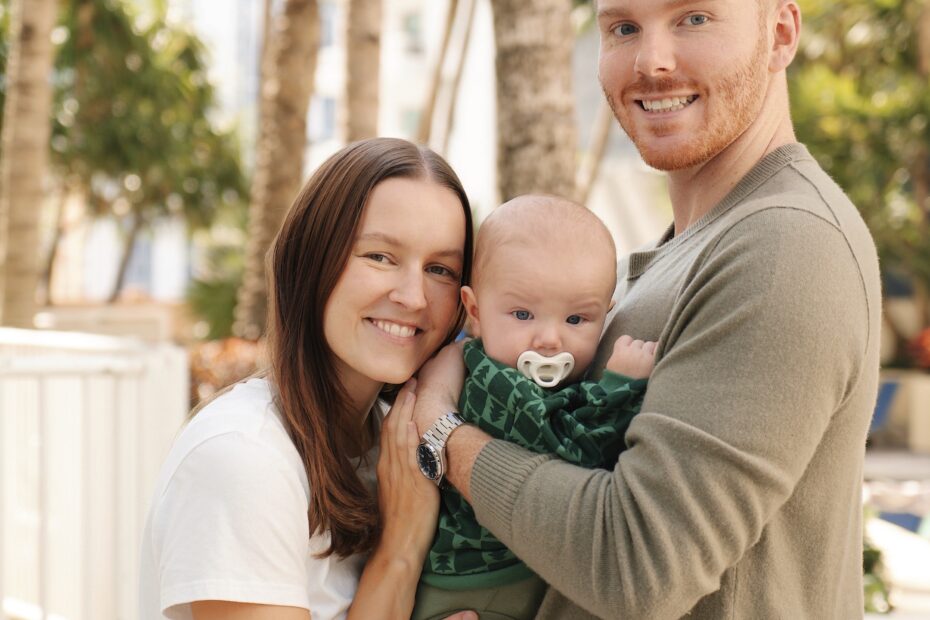
He wanted in. So he applied for a job at a Florida firm and moved with his wife and newborn to a downtown rental.
That’s the contradiction now defining South Florida’s housing market: The region is attracting high-earning newcomers eager to buy into its future, but many are still opting to rent a foothold first.
Why six-figure newcomers are renting instead of buying
LeBahn’s decision to rent was personal, but it was not unusual. Nationally, the share of households making at least $100,000 that rent rose from 18% in 2019 to 24% in 2024, according to data from the American Community Survey.
“Uncertainty kept high earners renting,” Jiayi Xu, senior economist at Realtor.com, explains.
Many of the professionals who poured into Miami and other hubs arrived without knowing how long they would stay, so they rented rather than buying. In aggregate, Xu says, that left the city with “high-income, price-insensitive tenants who’d rather pay a premium than commit to a purchase.”
LeBahn’s own move fits that pattern, even if his motivation was less caution than clear conviction. He had been looking for a city that offered a place to rest his ambitions and found one in Miami.
“You have a lot of the traditional infrastructure of a place like Chicago or New York, but there’s a lot more of a larger volume of, like, smaller, more innovative, flexible investment firms that I don’t think necessarily are represented nearly as much in these other hubs,” he explains. “It just feels very entrepreneurial.”
In that sense, renting was a way to make a bet on Miami without locking himself in. Then, of course, there’s the math.
Xu calculates that at the peak of migration in 2023, renting a typical Miami starter home cost $2,511 a month, while buying it would have resulted in a $3,540 monthly payment—a 41% premium.
Even on an average income of $178,382, Xu notes, the monthly mortgage obligation would have consumed nearly a quarter of the gross household income, and that was for an entry-level home.
LeBahn felt that mismatch firsthand. Miami rents were “notably higher than any other place that we’ve lived, even Chicago,” he says. However, renting still made more sense.
He expects to buy later, “just for the sake of lifestyle decisions.” But for the next few years, he says, he’s sticking with renting.
The luxury market stayed hot because affluent renters could absorb the shock
In most boom markets, softness starts at the top. New supply comes online, demand cools, and some of that relief eventually works its way down. It’s a dynamic at play in other Sun Belt metros.
Rents were down over 7% in Austin, TX, and Phoenix rents fell by 4%, according to data from Realtor.com, due at least in part to an oversupply of luxury units.
But when higher earners remain renters longer, they help keep pressure on the move-up units that often create breathing room elsewhere in the market. That may be in part why South Florida has bucked the trend and is behaving so differently from its peer markets.
“It’s such a resilient market,” LeBahn says, linking the resilience to “the sheer volume of people moving in, and just how warm the market is.”
Miami’s real advantage may be psychological: People think they need to get in now
While South Florida has always offered great weather and favorable tax policy, it’s the growing conviction—especially among finance workers and firms—that the region is becoming a new epicenter of power.
That belief is showing up in the office market as clearly as it is in housing.
In February 2026, Miami’s office vacancy rate stood at 12.8%, well below the national rate of 17.6%. Meanwhile, West Palm Beach and Miami posted the lowest office vacancy rates among the nation’s largest markets, according to an analysis from Miami Realtors. Class A and A+ office lease rates in the Miami market were up 64% cumulatively since 2019, and major leases in 2025 came from firms such as Amazon, ADP, Assurant, Uber, and Sidley Austin.
That’s part of what LeBahn was responding to when he moved.
“We were really attracted to just the growth that Miami has had,” he says.
That growth may be the most powerful force in the South Florida market today.
Before a city fully becomes a financial hub, it first becomes a bet—a place people pay to enter early because they believe the map is being redrawn in its favor. Right now, the office and residential rental markets look like the pot for that wager.