Sen. Maggie Hassan is escalating her scrutiny of corporate-owned mobile home parks in New Hampshire by asking residents to speak directly about conditions in the communities where they live.
On Tuesday, the ranking member of the Joint Economic Committee launched a confidential community survey for people living in manufactured housing communities—often called mobile home parks—seeking firsthand accounts of rent increases, living conditions, and treatment by park owners.
The survey marks a new phase in Hassan’s inquiry into investor-owned mobile home parks, which began in December when she pressed six of the state’s largest largest corporate owners to turn over detailed records on park ownership, financing, rent and fee practices, as well as maintenance spending.
“The residents of New Hampshire’s mobile home communities deserve affordable rent, safe living conditions, and the ability to protect themselves from mistreatment,” Hassan said via press release.
Private equity and corporate investors snapped up nearly $9.4 billion in mobile home parks in 2021 alone, according to the U.S. Government Accountability Office, fueling concern that rising investor interest is putting new pressure on one of the country’s last affordable paths to homeownership and wealth.
Hassan asks residents to weigh in on mobile home park conditions
Hassan is casting her inquiry as both a housing affordability issue and a resident protection issue, arguing that people living in these communities should be able to speak up about rising costs and deteriorating conditions.
“If you live in one of these communities, I would love to hear from you,” she said. “By completing the survey, you can share your experiences and support our work to protect Granite Staters from being pushed out of their own homes due to rising rents.”
Her office said responses will not be tied to residents’ names unless they explicitly agree—an important assurance, as reports of alleged retaliatory rent increases have cropped up across the country.
Those kinds of spikes can leave manufactured-home owners in park communities especially vulnerable during disputes, because while they may own the home itself, the high cost and difficulty of moving it gives landlords who control the land significant leverage.
Private equity ownership of mobile home parks faces growing scrutiny
At least 27 mobile home parks in New England, representing more than 5,200 housing units, are owned by private equity-backed companies, according to a database compiled by the Private Equity Stakeholder Project and Manufactured Housing Action.
That footprint is drawing wider attention from lawmakers who are examining investors’ role in the housing affordability crisis across the market.
This week, Sen. Elizabeth Warren also sent letters to the largest corporate landlords in the single-family, multifamily, and manufactured housing sectors, requesting data on their business practices, landlord-tenant concerns, and rental housing portfolios.
“Lot rents in manufactured housing communities have increased by 45% over the last decade,” Warren shared via press release.
She pointed to Massachusetts, where the state attorney general is suing an investor owner of a manufactured housing community for “unfair and retaliatory (lot) rent increases” of over 77% since 2022, with a cumulative 133% hike in new lease lot rents.
“Abusive practices by institutional investors in multifamily housing have also driven up costs for some renters. Some of the largest owners of multifamily housing have been the subject of federal anticompetition lawsuits against their use of price-fixing algorithms that allow them to artificially inflate rent prices,” she added.
Why the fight over mobile home parks matters
Mobile homes remain one of the last affordable paths to homeownership for many families, which is part of why scrutiny of park ownership carries such high stakes.
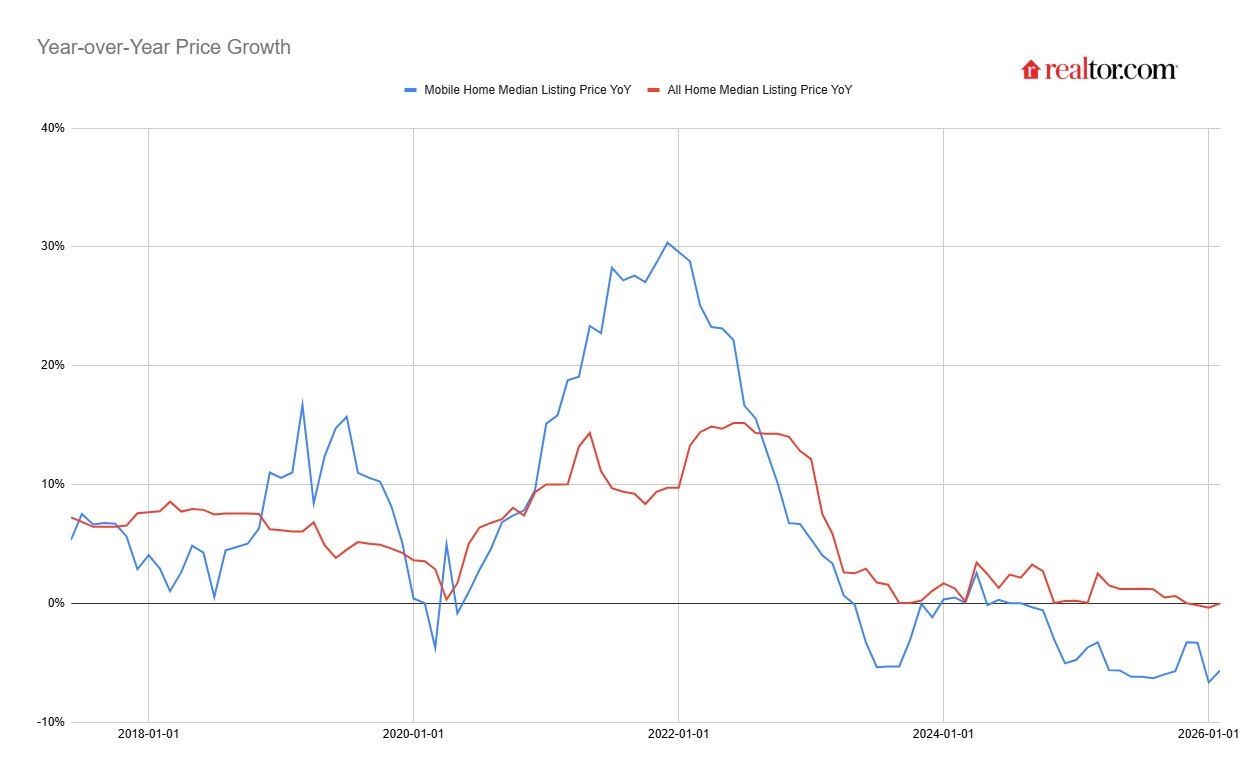
The median mobile home listing price is just $141,450, compared with $410,000 for a single-family home. The monthly housing cost differential is even more striking: The estimated monthly principal and interest on the median mobile home is just to $678, versus $1,918 for a nonmobile home.
Recent research from Realtor.com® has also found that manufactured housing can still help owners build wealth, even when the home is on a leased lot in a park.
Mobile homes without land appreciated 51.6% from 2019 to early 2026, compared with the median single-family home appreciation of 58.6%. Mobile homes with land, meanwhile, appreciated 70.1%, the report found.
“We are definitely fighting the narrative that mobile homes are necessarily depreciating assets,” Joel Berner, senior economist at Realtor.com and author of the report, said of the data, while noting that such homes can still lose value in flat or declining markets.
That’s what makes the issue so fraught: Manufactured or mobile homes can offer a real path to equity and generational wealth, but that path can become far more precarious when residents own the home but not the land beneath it. When investors raise lot rents, add fees, or fail to maintain basic conditions, the consequences can be especially severe.