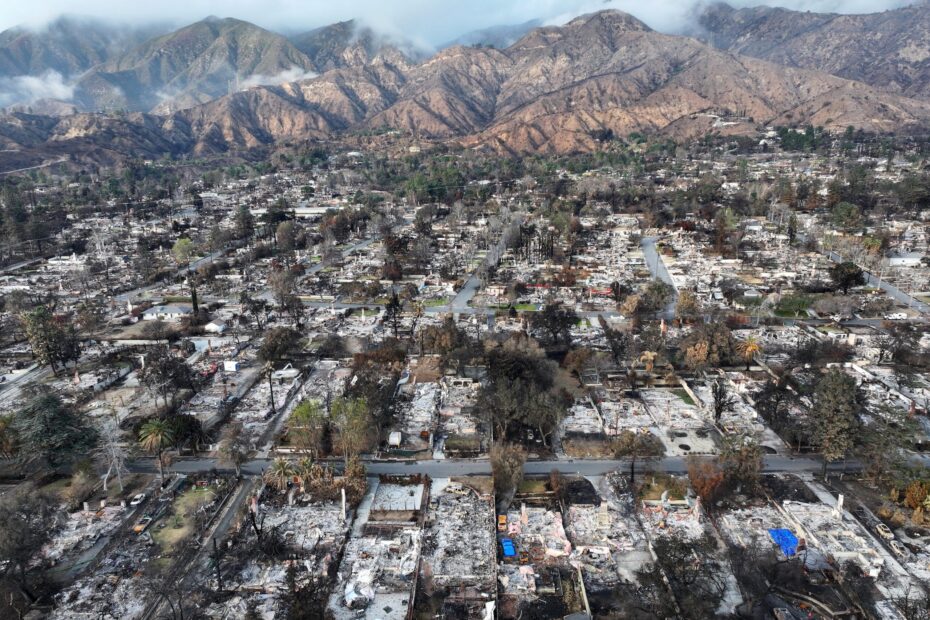
President Donald Trump has signed an executive order enabling the federal government to take over the cleanup and rebuilding efforts from the California wildfires, which caused tens of billions of dollars worth of losses to homes and property.
In the Jan. 27 order, Trump leapfrogged local government officials, including L.A. Mayor Karen Bass, in order to allow the Federal Emergency Management Agency and the Small Business Administration to start expediting permitting and approvals of homes. This comes one year after the January 2025 wildfires consumed nearly 40,000 acres in and around Los Angeles.
The White House has vowed that this move will speed up rebuilding efforts for properties destroyed in the Palisades and Eaton fires. Thousands of residents are still displaced, and some say they’re frustrated with the pace of cleanup and rebuilding efforts.
New regulations hit at “delay”
Trump has now pledged to end that “nightmare of delay, uncertainty, and bureaucratic malaise as they remain displaced from their homes.”
The order, which was first reported by the California Post, requires preliminary regulations put forth within 30 days. Final regulations are due within 90 days. They must allow permits, waivers, reviews and approvals to be conducted in a way that expeditiously promotes rebuilding, states the order.
“I want to see if we can take over the city and state and just give the people their permits they want to build,” Trump told the Post.
In place of those rules, the regulation lets builders self-certify to a federal designee that they complied with state and local health and safety standards for projects that use federal emergency relief funds.
The government will assess whether California awarded any of the $3 billion in unspent Hazard Mitigation Grant Program funding “arbitrarily, capriciously, or contrary to law.”
Trump blames local leaders for “failure to rebuild”
Trump also took aim at California’s Democratic leaders in the order. He accused “state and local government [of failing] to engage in responsible forest management systems out of a misguided commitment to naturalist and climate policies, which increased the severity of the fires.”
He also alleged that inadequate maintenance of “water distribution and reservoir systems” meant the fires could not be quickly brought under control.
“They then failed to quickly communicate evacuation warnings and failed to act decisively or cohesively to contain the fire once it started burning,” he continued. “In fact, Mayor Karen Bass was not in Los Angeles to respond to the crisis because she was traveling abroad.
“This marked one of the greatest failures of elected political leadership in American history, from enabling the wildfires to failing to manage them, and it continues today with the abject failure to rebuild.”
California Gov. Gavin Newsom, hit back at Trump in a response posted to X, stating that “an executive order to rebuild Mars would do just as useful.”
“The Feds need to release funding not take over local permit approval speed—the main obstacle is COMMUNITIES NOT HAVING THE MONEY TO REBUILD,” Newsom’s press office said.
Newsom says Trump “is failing to approve long-term disaster funding.” California wants it to fund the rebuilding of schools, childcare centers, water systems, and infrastructure, as well as air-quality monitoring.
Inside California’s rebuilding efforts
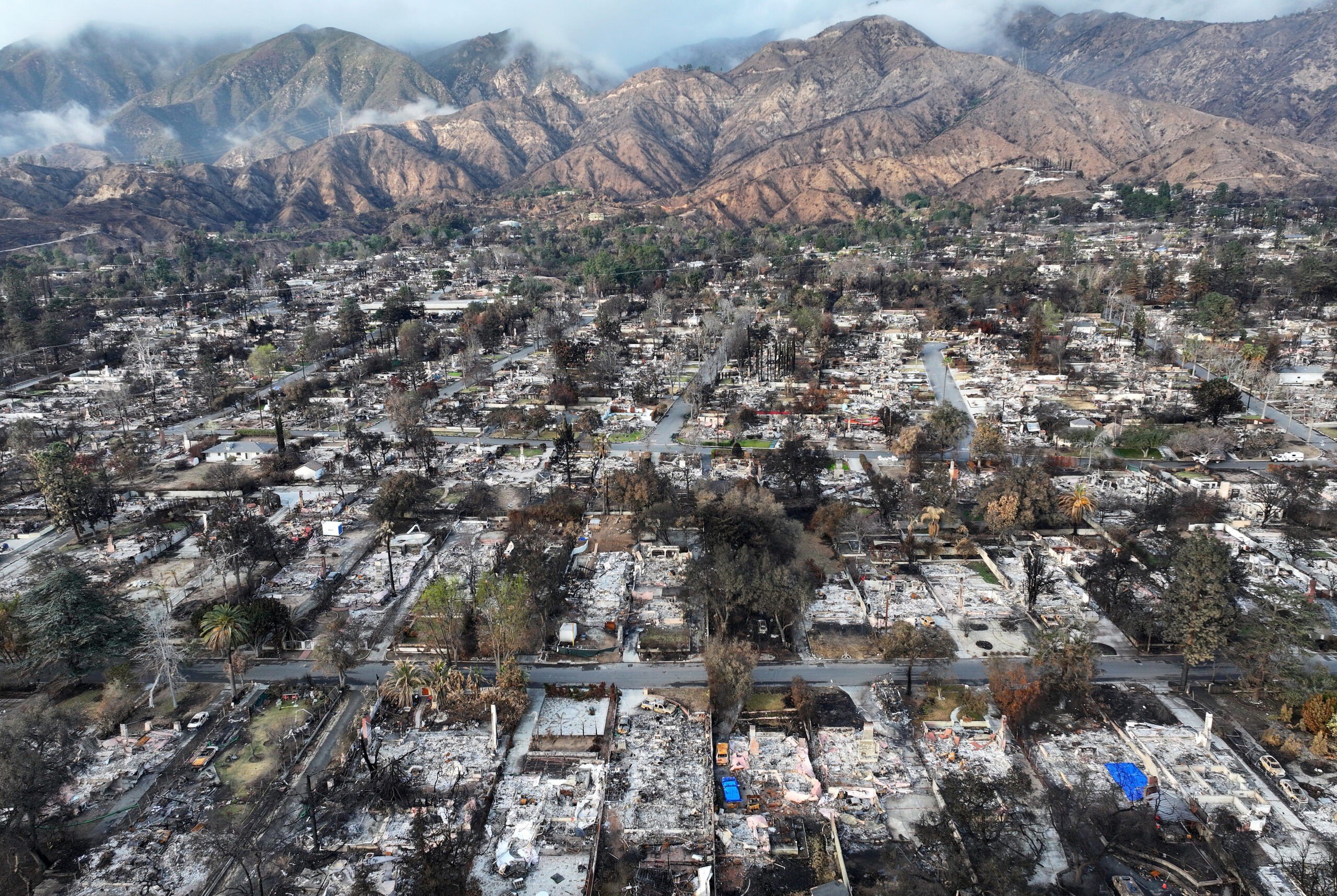
The fires were the most destructive in California’s history. The UCLA Anderson Forecast estimates total property and capital losses range between $76 billion and $131 billion, with insured losses estimated at up to $45 billion.
And fires destroyed 16,000 structures—an estimated 12,000 of them homes.
Realtor.com data show the fires destroyed estimated $8.3 billion in home value in two hard-hit communities alone. Altadena saw its combined home values fall from $14.7 billion to $10.8 billion between late 2024 and late 2025.
In Pacific Palisades, it fell from from $7 billion to $4.7 billion. And in both cities, properties damaged and located near the fire declined in value, Realtor.com data show.
Rebuilding efforts vary across the cities. Los Angeles’ rebuilding dashboard shows 3,260 applications to rebuild. Of them, 1,275 are in review, and 1,985 have been approved. It has issued 1,646 permits as of Tuesday, Jan. 27.
Los Angeles County, which saw 7,417 housing units destroyed, has issued 1,328 permits—including to Altadena, according to its permitting progress dashboard. Malibu, which lost 600 homes, approved 24 permits, according to the city’s rebuild dashboard.
The federal government has cleared 9,500 properties in the past six months, removing 2.6 million tons of debris, the White House says.
What the rebuilding process looks like
Newsom funded programs to support the construction workforce needed to rebuild. The state announced plans to invest $107 million in affordable housing to rebuild about 700 rental units.
California also created tax incentive programs to help local businesses get back on their feet.
But the White House says the state and municipalities aren’t moving fast enough to approve reconstruction. It blamed “burdensome, confusing, and inconsistent permitting requirements, duplicative permitting reviews, procedural bottlenecks, and administrative delays” for stalling recovery.
“American families and small businesses affected by the wildfires have been forced to continue living in a nightmare of delay, uncertainty, and bureaucratic malaise as they remain displaced from their homes, often without a source of income, while State and local governments delay or prevent reconstruction by approving only a fraction of the permits needed to rebuild,” states the White House order.